Language
Content
A CNC wire bending machine is an automated manufacturing system that feeds, positions, and bends metal wire into precise geometric shapes using computer-controlled servo motors and programmable tooling. The short answer to whether you need one: if your production volume exceeds a few hundred identical wire parts per day, manual or semi-automatic bending is almost certainly costing you more than the machine itself. Modern CNC wire benders can produce complex 2D and 3D wire forms with tolerances as tight as ±0.1 mm, at speeds that manual operators simply cannot match consistently.
The same platform that bends structural wire forms also operates as a spring bending machine when equipped with appropriate tooling and software modules. This dual-function capability is one reason CNC wire bending machines have become the default choice in industries ranging from automotive seating to medical device manufacturing. Rather than investing in two separate systems, manufacturers configure a single CNC platform to handle both wire forms and compression or torsion springs depending on the production schedule.
This article covers how these machines work, what separates entry-level from high-end models, which industries rely on them most heavily, and what you should evaluate before purchasing or upgrading a system.
Understanding the mechanical sequence helps you evaluate machine specs intelligently rather than comparing brochure figures in isolation. The process begins at the wire feed system, where a straightener removes coil-set from spooled wire before it enters the bending head. Feed accuracy at this stage is critical — a 0.5 mm error per feed cycle compounds across a complex 20-bend part into a completely unusable component.
The bending head is the heart of any CNC wire bending machine. It typically consists of a central bending pin, a bending finger that rotates around it, and a clamping mechanism that holds the wire during the bend. On entry-level machines, the bending direction is fixed, meaning the operator must rotate the wire manually for complex 3D parts. On mid-range and industrial systems, the bending head itself rotates — often called a rotary bending head — allowing the machine to create 3D wire forms in a single uninterrupted cycle.
High-end systems from manufacturers such as Wafios, BendRobotics, and Meba feature bending heads with up to 7 controlled axes, enabling geometries that would be impossible on conventional equipment. The tooling itself — pins, fingers, and formers — is typically made from hardened tool steel or carbide and is sized to match the wire diameter. Changing between wire diameters usually requires a tooling swap that takes 15–45 minutes depending on machine design.
Modern CNC wire bending machines replace hydraulic actuators with AC or DC servo motors on each axis. Servo-driven systems respond faster, consume less energy, and allow the controller to record positional data in real time for quality verification. The motion controller — typically a proprietary CNC unit or an industrial PC running specialized software — interprets the programmed bend sequence and coordinates all axes simultaneously. Feed speed, bend angle, bend direction, and cutting are all synchronized to within milliseconds.
Some machines use a cam-driven mechanical system for simple, high-volume parts where servo flexibility is unnecessary, but these are increasingly rare in new installations. The trend is firmly toward all-servo platforms because they accommodate rapid program changes — a necessity in job-shop environments where 20 different wire forms might run in a single shift.
Wire is cut after bending using either a shear-cut or a rotary-cut mechanism. Shear cutting is faster and works well for soft to medium-hard wire up to about 8 mm diameter. Rotary cutting produces a cleaner end finish with minimal burr, which is important in applications where wire ends contact seals, moving parts, or human skin. Some spring bending machine configurations use a dedicated cut-off tool that also forms the end coil simultaneously, eliminating a secondary operation.
CNC wire bending machines are not a single category. The market spans machines that cost under $30,000 and produce simple 2D brackets, to systems exceeding $500,000 that bend heavy structural wire for automotive or construction applications. Choosing the wrong category is the most common and expensive mistake buyers make.
| Category | Wire Diameter Range | Axes | Typical Output | Primary Use |
|---|---|---|---|---|
| 2D CNC Wire Bender | 0.5 – 6 mm | 2–3 | 800–2,000 pcs/hr | Flat brackets, handles, hooks |
| 3D CNC Wire Bender | 1 – 10 mm | 4–7 | 200–800 pcs/hr | Seat frames, medical forms, display racks |
| Spring Bending Machine | 0.3 – 8 mm | 3–6 | 50–600 pcs/min | Compression, extension, torsion springs |
| Heavy-Duty Wire Former | 6 – 20 mm | 4–6 | 50–300 pcs/hr | Construction rebar stirrups, trailer frames |
A 2D CNC wire bending machine bends wire in a single plane. The finished part can be lifted off a flat surface without any portion rising above or below that plane. This covers a very large proportion of wire forms used in retail fixtures, HVAC components, and consumer hardware — products where the added cost of 3D capability is unnecessary. A 3D machine adds a rotation axis to the bending head or the wire feed tube, allowing the part to spiral or twist in three dimensions. Automotive seat frames, ergonomic lumbar supports, and complex medical wire guides all require 3D capability.
A spring bending machine is technically a specialized variant of the CNC wire bending machine family, optimized for coiling wire into spring geometries. The key mechanical difference is the coiling tool — a hardened former positioned precisely relative to the wire centerline to control coil diameter — combined with a pitch tool that advances the coils axially. Modern CNC spring bending machines can produce compression springs, extension springs with open or closed hooks, and torsion springs with arbitrary leg angles, all within the same program cycle. Switching between spring types typically requires only a program change and minor tooling adjustment rather than a full machine changeover.
The material being bent affects every aspect of machine selection: the required bending force, the tooling geometry, the springback compensation needed, and the wear rate of tooling. Assuming that a machine specified for mild steel wire will perform equally well on stainless or high-carbon spring wire is a common and costly error.
Springback — the elastic recovery of wire after a bend is released — varies significantly between materials and even between wire lots of the same material. High-quality CNC controllers include springback compensation tables that adjust the actual programmed bend angle beyond the target angle to achieve the correct final geometry. Some systems use in-process measurement with a camera or contact probe to detect actual bend angles and correct in real time, reducing scrap on the first parts of a new program run.
Two machines with nearly identical mechanical specifications can produce very different real-world results depending on the software platform. Programming time, changeover efficiency, and the ability to import geometry from CAD systems are now as important as mechanical capability — especially in environments with short production runs and frequent part changes.
Leading CNC wire bending machine software platforms — including Wafios Wafios FMG, Simplex, and Numalliance's proprietary systems — allow operators to import wire geometry directly from DXF or STEP files. The software calculates the required bend sequence, tooling positions, and estimated springback automatically. This means a new part program can be created offline in 20–60 minutes rather than spending hours on the machine running trial pieces. In high-mix environments, this capability alone can recover 2–4 machine-hours per shift that would otherwise be lost to changeover.
Before running a new program on the actual machine, simulation software renders the complete bending sequence in 3D, flagging potential collisions between the bending tooling, the wire, and already-bent portions of the part. This is especially valuable for complex 3D wire forms where a blind bend could drive the wire into the machine head. Catching a collision in simulation rather than in production prevents tooling damage that can cost $2,000–$15,000 to repair depending on machine type.
Spring bending machine software adds parameters not present in general wire bending programs: coil diameter, pitch, free length, number of active coils, and end configuration. Advanced platforms allow the operator to enter the spring's functional specification — spring rate, working load at a given deflection — and the software back-calculates the required wire diameter and coil geometry, then generates the machine program automatically. This eliminates the manual iteration that spring designers traditionally performed through trial coiling and load testing.
Modern CNC wire bending machines increasingly support OPC-UA or MQTT data protocols, allowing production data — cycle count, fault codes, bend force readings, and program identifiers — to stream to manufacturing execution systems in real time. This enables production planners to monitor output against schedule without walking the floor, and maintenance teams to track tooling wear cycles and schedule replacement before failures occur. Machines that lack these interfaces are becoming a liability in facilities that are implementing plant-wide data collection strategies.
The global wire forming equipment market was valued at approximately $1.8 billion in 2023 and continues to grow, driven primarily by automotive lightweighting requirements, growth in the medical device sector, and the expansion of e-commerce fulfillment infrastructure that demands enormous volumes of wire storage and display components.
Automotive is the largest single end-market for CNC wire bending machines. A typical passenger vehicle contains 200–400 individual wire forms, ranging from seat frame springs and lumbar support bows to hood prop rods, windshield wiper linkages, and engine bay cable guides. Electric vehicles add wire form complexity in battery module retention systems and thermal management assemblies. Tier 1 automotive suppliers typically operate multiple CNC wire bending machines per production cell, with changeover times under 10 minutes as a contractual expectation from OEM customers.
Medical wire bending encompasses nitinol guidewires, stainless surgical tools, orthopedic implant components, and the intricate wire frames used in minimally invasive surgical devices. These applications demand the highest possible positional accuracy — tolerances of ±0.05 mm are common — combined with complete traceability of material lot and machine parameters for regulatory compliance. CNC wire bending machines used in medical production typically run certification programs that log every bend parameter for each part and store data against a unique part serial number.
Dedicated spring manufacturers operate CNC spring bending machines as their primary production equipment. A mid-sized spring shop might run 5–20 CNC spring bending machines simultaneously, each producing a different spring type. Applications span automotive suspension and valve train springs, industrial machinery springs, consumer electronics (keyboard switches, pen mechanisms), and aerospace actuation systems. The spring bending machine segment is one of the fastest-growing sub-categories due to demand from the electric vehicle battery system and energy storage sectors, where precise spring loading is critical to cell compression and thermal contact management.
Wire display racks, shelf dividers, peg hooks, and basket systems are produced in enormous volumes by specialized wire form manufacturers serving retail chains. This segment values high throughput over extreme precision — a 2D CNC wire bending machine running at 1,500 parts per hour on a simple retail hook program represents the core of many display fixture businesses. The low material cost and commodity-level pricing in this segment place a premium on machine uptime and changeover efficiency.
Refrigerator shelving, oven racks, washing machine drum supports, and HVAC grille frames are all wire form products manufactured on CNC wire bending machines. These are high-volume, relatively simple wire forms where a 2D or simple 3D machine running in automated mode with minimal operator intervention is the standard production model. Stainless steel and galvanized mild steel are the dominant materials in this segment.
Machine specifications are not always directly comparable across manufacturers, and some figures are stated under best-case conditions that may not reflect your actual production requirements. The following criteria should be evaluated critically for every purchase decision.
Published cycle time figures from machine manufacturers represent ideal conditions — clean wire, simple geometry, optimal tooling, experienced operator. Actual production in a typical manufacturing environment runs at 65–85% of rated throughput when accounting for material changeovers, minor stoppages, scrap on program startup, and scheduled maintenance. Planning around 70% of rated throughput is a conservative and defensible approach for capacity planning purposes.
Consider a job shop producing a stainless steel wire form with 12 bends, using a 4-axis CNC wire bending machine rated at 400 parts per hour on mild steel 4 mm wire. With stainless of the same diameter, expect a 30–40% speed reduction due to the higher material strength — call it 250–280 parts per hour at full efficiency, or roughly 175–200 parts per hour at 70% utilization. Over an 8-hour shift, that yields approximately 1,400–1,600 parts — a figure that must align with your daily demand and inventory targets before committing to a machine purchase.
For spring bending machine applications, throughput depends heavily on spring complexity. A simple cylindrical compression spring with no special end configuration might run at 300–500 pieces per minute on a high-speed CNC coiler. A torsion spring with two precisely positioned legs at different angular orientations might run at only 20–50 pieces per minute. Both are produced on the same machine category — the geometry drives the output rate, not just the machine's rated speed.
The purchase price of a CNC wire bending machine is typically 50–65% of its total cost over a 10-year operating life. Tooling, maintenance, and energy consumption account for the remainder. Understanding these costs upfront prevents budget surprises that undermine the business case for the investment.
Bending pins and fingers are consumable items. On a high-production machine running stainless wire, a bending pin might last 500,000–2,000,000 cycles before replacement. At 250 parts per hour with 12 bends per part, that's 3,000 bends per hour — meaning a pin could need replacement every 170–670 hours of production time. Carbide tooling lasts 3–5× longer than standard tool steel but costs 4–6× more per unit. The right choice depends on your production volume and downtime tolerance.
Manufacturers typically recommend daily lubrication checks, weekly inspection of straightener rollers and drive rollers, monthly inspection of servo motor couplings and encoder feedback, and annual inspection of the bending head bearing assembly. Machines that operate in dusty or wet environments — common in fabrication shops — require more frequent cleaning and inspection of electrical enclosures. Neglecting the straightener system is the most common maintenance error: worn straightener rollers allow residual coil-set in the wire, which introduces positional errors that appear as random variation in finished part geometry.
An all-servo CNC wire bending machine in the 4–8 mm wire diameter range typically draws 3–8 kW during active bending, with peaks during the acceleration phase. This is substantially lower than equivalent hydraulic machines, which idle at full pump pressure. The energy savings from switching from hydraulic to servo-driven systems often contribute meaningfully to a machine upgrade's payback calculation, particularly in facilities with high electricity costs or active carbon reduction programs.
A standalone CNC wire bending machine is often only one component in a broader automated production cell. The output of the bending machine may feed directly into a welding fixture, a forming press, an assembly station, or an inspection system. Designing these interfaces correctly from the outset is significantly cheaper than retrofitting them after installation.
Common downstream automation configurations include conveyor belt discharge for high-volume 2D wire forms, robotic part placement for 3D forms where orientation matters for downstream assembly, vision inspection systems that check finished part geometry against a CAD template and reject out-of-tolerance parts before they reach the assembly line, and automated coil reel changers that splice incoming wire without stopping the machine — eliminating the single largest source of unplanned downtime on high-production CNC wire bending installations.
For spring bending machine cells, automated counting, sorting, and packaging systems are standard in high-volume spring manufacturing. Springs are discharged into vibratory bowl feeders that orient them for automated packaging or secondary operations such as heat setting, shot peening, or coating. Integrating these systems requires careful attention to spring geometry — a spring that is prone to tangling will cause persistent jams in vibratory handling equipment, a problem that is far easier to solve at the design stage than after equipment is installed.
There is no universal threshold, but most manufacturers find that CNC wire bending becomes cost-effective at volumes above 500–1,000 identical parts per day for a part requiring more than 3 bends. Below this volume, manual or semi-automatic tooling with simpler equipment typically offers better return. Job shops handling very high-mix, low-volume work sometimes justify CNC machines specifically for their rapid changeover capability rather than throughput alone.
Yes. Many modern CNC wire bending platforms can be configured for spring coiling by fitting the appropriate coiling and pitch tooling. The software must also support spring parameters. However, a machine optimized for wire forms may not achieve the feed speed or angular resolution needed for fine-wire, high-speed spring production. If springs are your primary product, a purpose-built spring bending machine will outperform a general-purpose wire bender adapted for spring work.
With offline programming software and a DXF file of the finished part, an experienced programmer can generate a working program in 30–90 minutes for a standard 2D or 3D wire form. On-machine programming without offline tools can take 2–6 hours for complex parts, including test runs and adjustments. Spring programs are often faster because the geometry is more regular and the software does more of the calculation automatically.
Standard machines handle mild steel, stainless steel (with derated capacity), and aluminum. High-carbon spring wire is handled by spring-optimized machines and some general wire benders. Titanium, Nitinol, and specialty alloys typically require modified or custom machines, and some applications require heated tooling to achieve adequate ductility.
The machine controller adds a calculated overbend to each programmed angle to compensate for elastic recovery after the tooling releases. This compensation value is determined empirically — the machine bends test pieces, measures the actual angle achieved, and calculates the correction needed. Modern systems build springback tables by material type and diameter, so compensation is applied automatically when a material is selected. In-process measurement systems can update compensation values in real time based on actual measured results, reducing the number of test pieces needed when starting a new program.
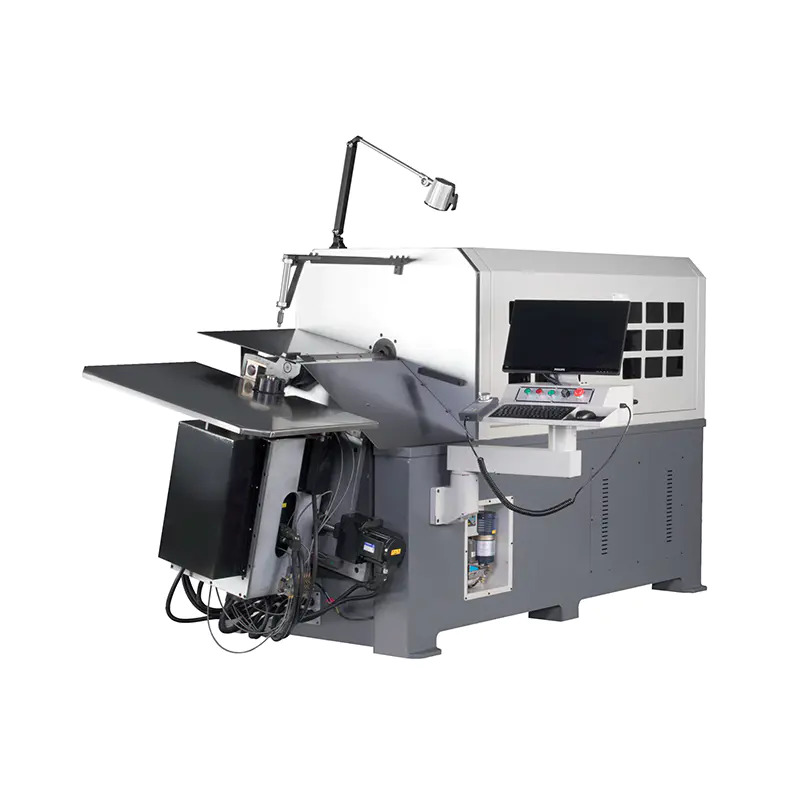
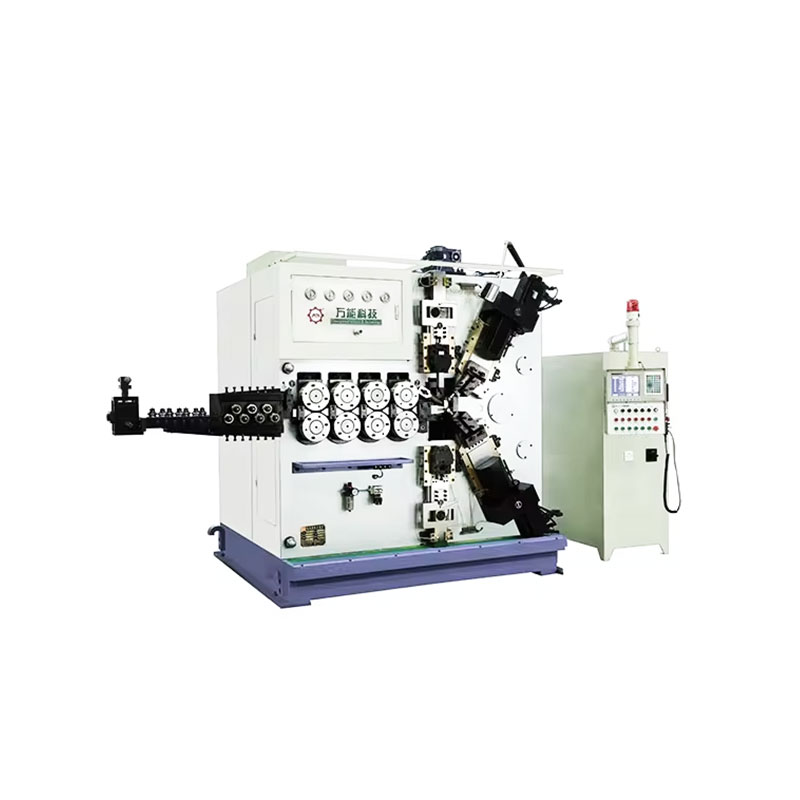
TK-6160 TK-6160 CNC SPRING ROLLING MACHINE...
See Details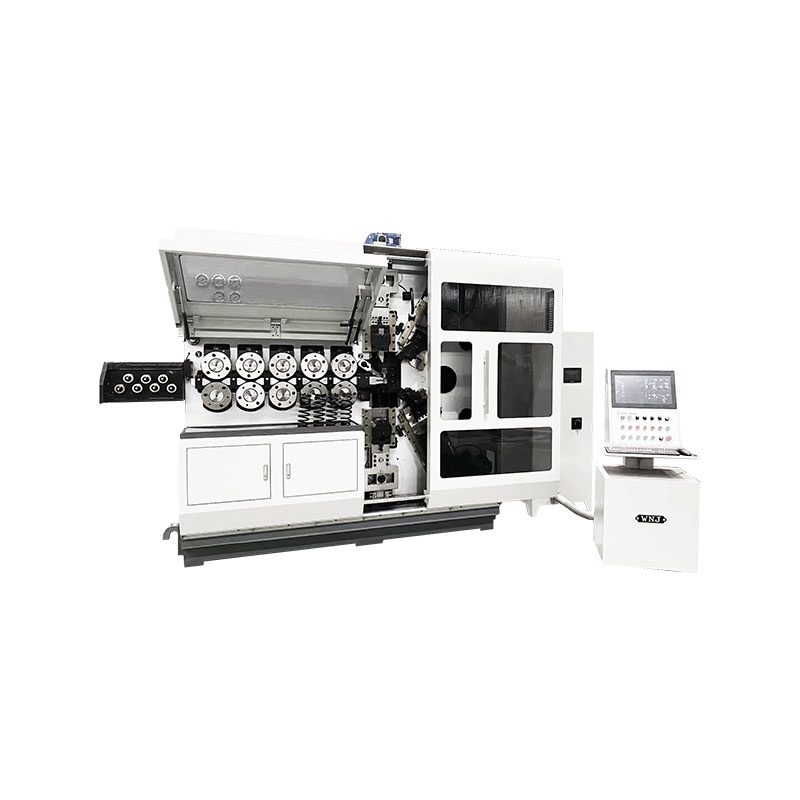
TK-6120 TK-6120 CNC SPRING ROLLING MACHINE...
See Details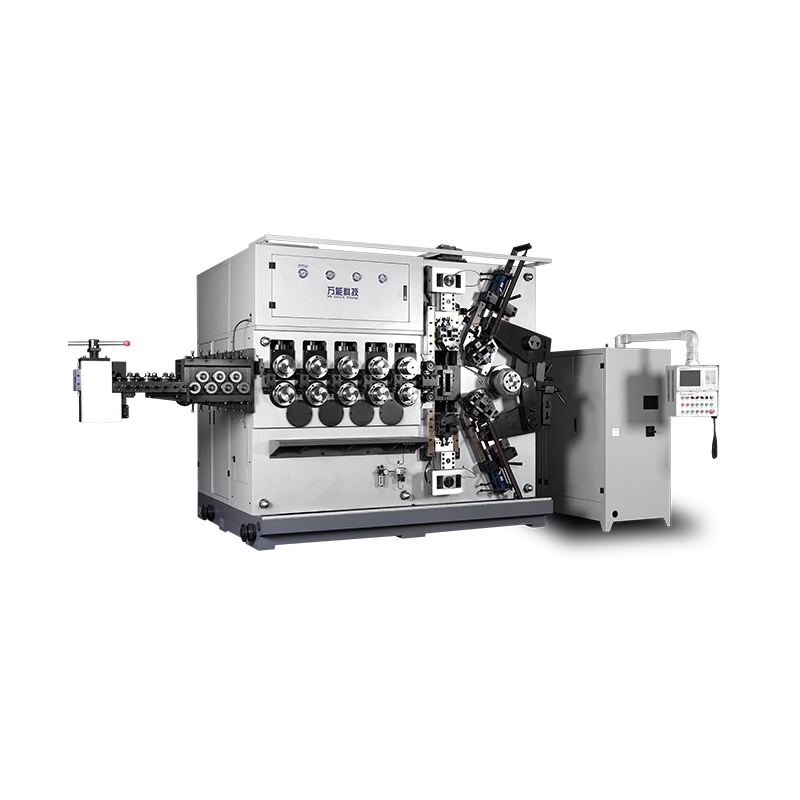
TK-5200 TK-5200 5AXES CNC SPRING COILING MACHINE...
See Details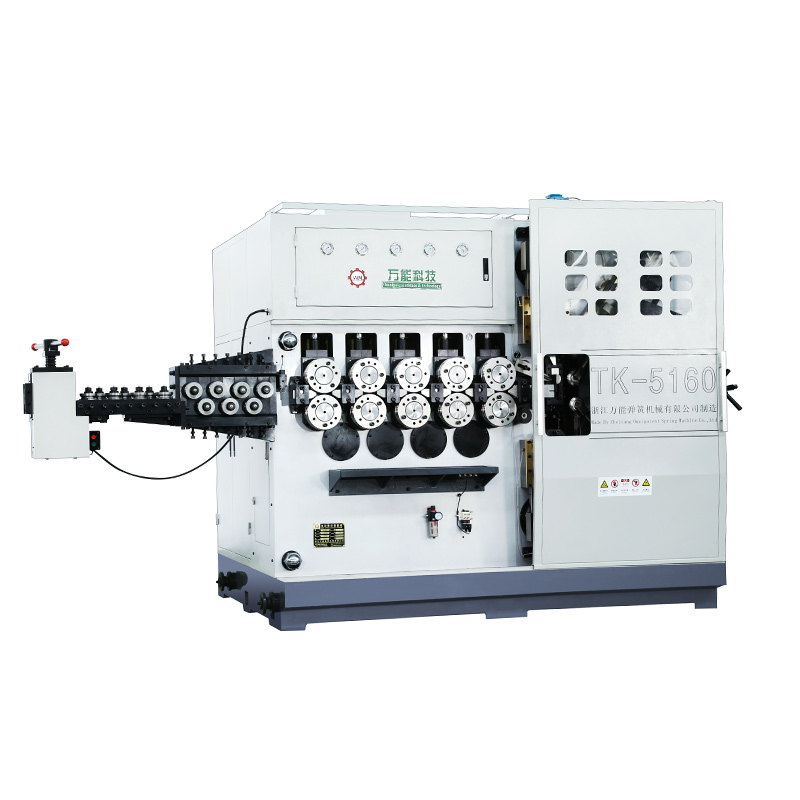
TK-5160 TK-5160 5AXES CNC SPRING COILING MACHINE...
See Details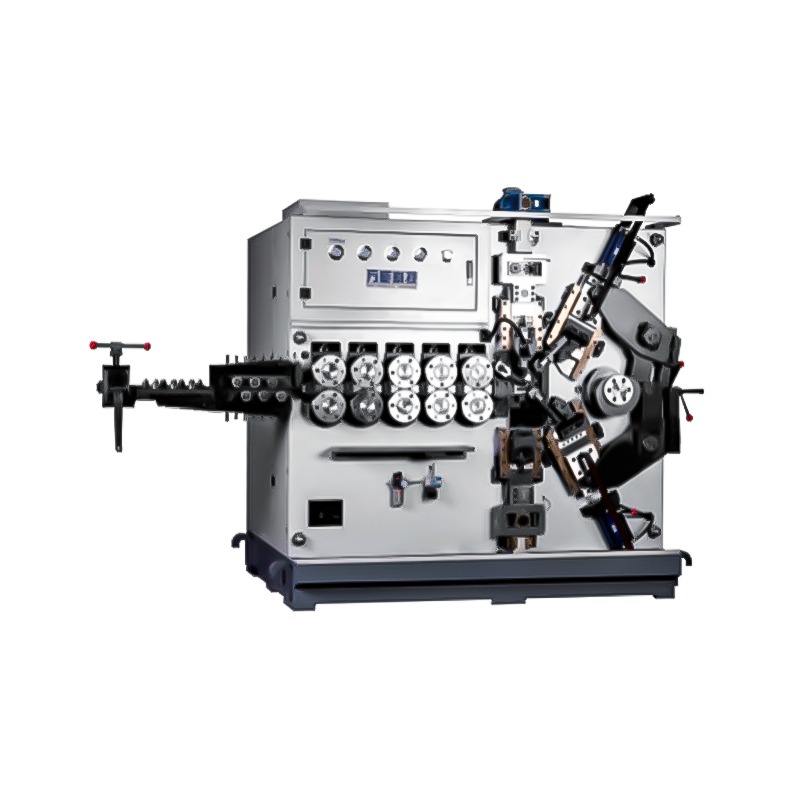
TK-5120 TK-5120 5AXES CNC SPRING COILING MACHINE...
See Details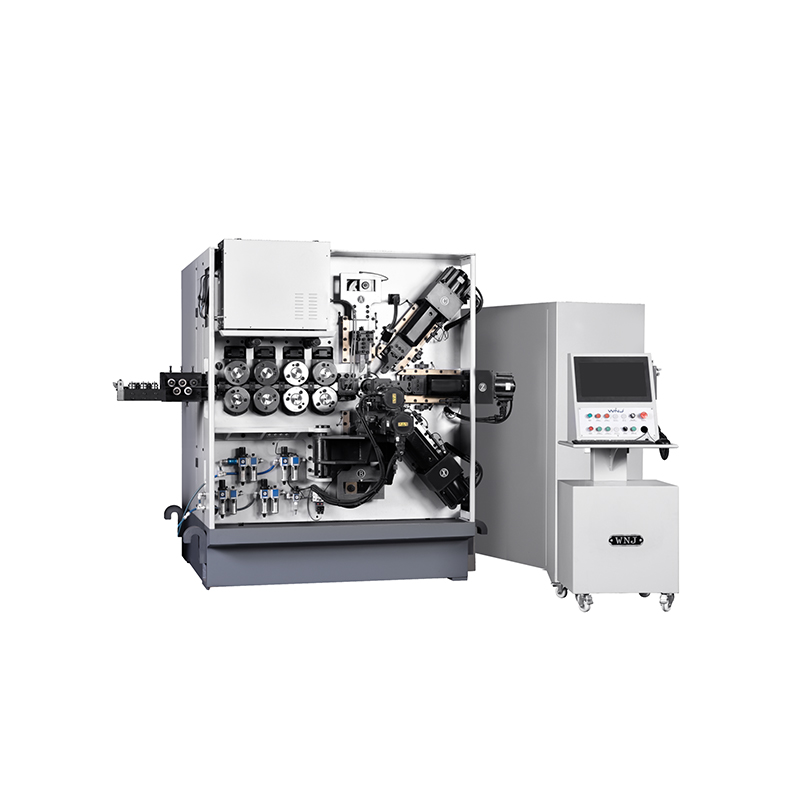
TK TK 10AXES CNC SPRING SCROLL MACHINE...
See Details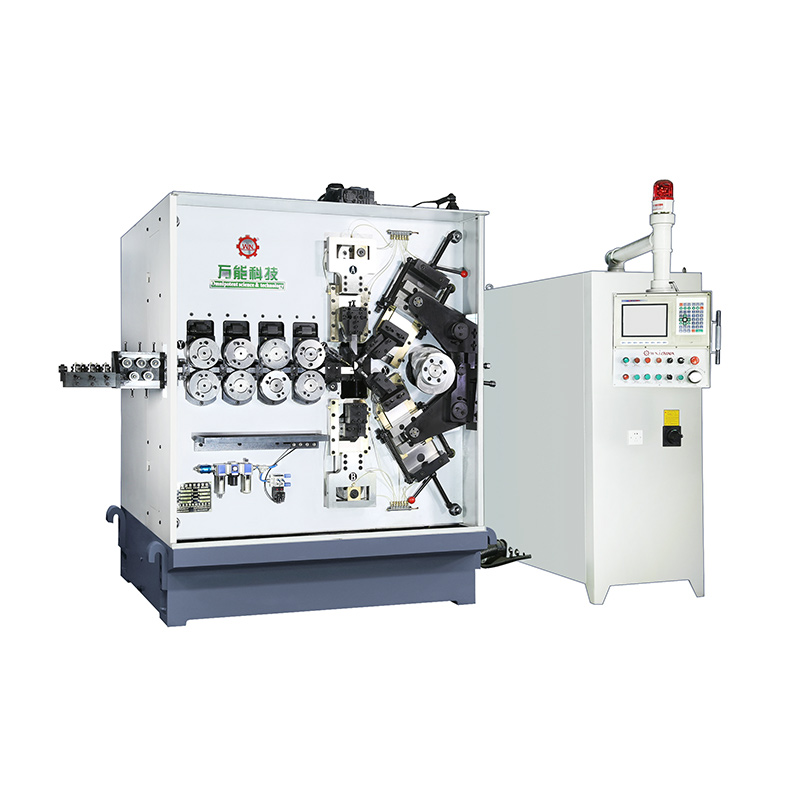
TK-580B、 TK-590 TK-580B、 TK-590 5AXES CNC SPRING COILING MACHINE...
See Details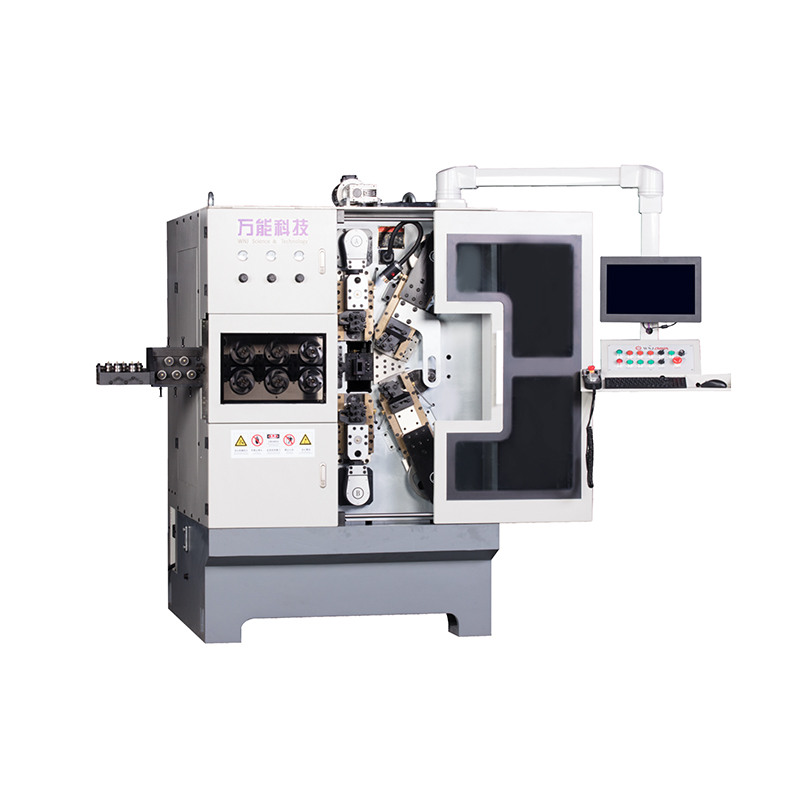
TK-760TK-760 6-7AXES CNC SPRING COILING MACHINE...
See DetailsMobile QR Code

 中文简体
中文简体 English
 русский
 Español